
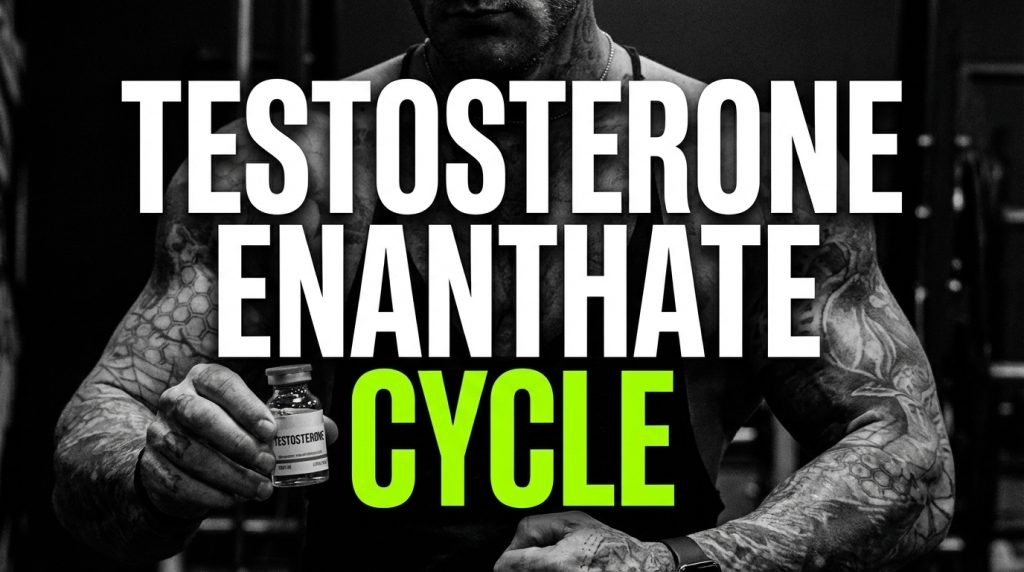
You run your first cycle.
Result is muscle, some fat, and broken lipids.
Second cycle, the gains are slower and the sides are worse.
You blame genetics or the compound.
The real reason? No planning. No bloodwork. No system.
Here is how to actually structure a testosterone enanthate cycle for a beginner — not a forum recommendation, but a system that protects your health while maximizing growth.
Last Updated: March 2026 | Coach Angelo
What Is Testosterone Enanthate?
Testosterone enanthate is a long-ester form of testosterone — the enanthate ester extends the half-life to approximately 10–12 days in blood. This means once-weekly injection maintains stable serum levels, unlike shorter esters which require more frequent dosing.
It is schedule-controlled (Schedule II/III) in most countries. Possession without prescription is illegal. This article is educational — it describes how cycles are structured in medical and underground contexts. It is not an instruction to obtain or use controlled substances illegally. Your jurisdiction, your liability.
Testosterone is the baseline compound for first-cycle design because it is well-studied, side effects are manageable with proper monitoring, and results are predictable. Starting with testosterone enanthate alone allows you to understand your individual response to androgens before adding complexity.
How Testosterone Enanthate Works: Endocrine Mechanism
Testosterone binds to androgen receptors throughout the body. Primary sites: muscle tissue (hypertrophy), bone (density/strength), brain (mood, aggression, motivation), and reproductive organs (libido, fertility).
At the pituitary: High testosterone suppresses GnRH (gonadotropin-releasing hormone) via negative feedback, which in turn suppresses LH (luteinizing hormone) and FSH (follicle-stimulating hormone). This is the mechanism of endogenous testosterone shutdown — your testes stop producing their own testosterone because exogenous testosterone is present at high levels.
Aromatization: Testosterone is partially converted to estradiol (E2) via the aromatase enzyme. Elevated estradiol causes gynecomastia (breast tissue growth), water retention, and fat storage in female-pattern distribution. The degree of aromatization is individual and dose-dependent.
5-alpha reduction: Testosterone is converted to DHT (dihydrotestosterone) via 5-alpha reductase. DHT is more androgenic than testosterone — it causes male pattern baldness, acne, and increased aggression in sensitive individuals. Dose matters.
Growth signaling: Elevated testosterone stimulates mTOR pathway, increases protein synthesis, improves nitrogen retention, and increases glycogen storage. The result is rapid muscle gain, fat loss potential, and improved strength. This is the mechanism of the anabolic effect — faster recovery and muscle growth than natural testosterone levels allow.
Cardiovascular impact: Testosterone increases hematocrit (red blood cell count), LDL cholesterol, and can increase blood pressure. These changes occur in most users and require monitoring.
Benefits of Testosterone Enanthate for Muscle Gain
Rapid Muscle Hypertrophy
A beginner on testosterone enanthate gains muscle at a rate of 0.5–1.0kg per week in the first 4–8 weeks, dependent on training stimulus, nutrition, and individual response. This is 4–8x faster than natural progression. The mechanism: enhanced protein synthesis, increased nitrogen retention, improved recovery between sessions, and enhanced central nervous system drive (you can lift heavier weight more times).
The gain is not pure muscle — water retention and fat gain are also present. But the lean tissue component is significant and sustainable post-cycle if training and nutrition are maintained.
Improved Strength and Recovery
Strength gains are rapid and dramatic. A beginner bench pressing 100kg can reasonably press 120kg within 8 weeks on testosterone. Recovery between sessions improves — you can train the same muscle group more frequently or with higher volume without fatigue accumulation. This allows for more productive training sessions per week.
Enhanced Motivation and Drive
Testosterone directly affects the brain. Most users report increased confidence, motivation, focus, and reduced anxiety. This is not placebo — testosterone is a neuroactive hormone. The mechanism is dopamine, GABA, and serotonin modulation. Practical value: you push harder in training, you are less likely to skip sessions, adherence to diet improves.
Fat Loss Potential (If Deficit Is Run)
Testosterone increases basal metabolic rate slightly and improves insulin sensitivity. If a calorie deficit is maintained during a testosterone cycle, fat loss can occur simultaneously with muscle gain — “body recomposition.” This is only possible during the first cycle or after a long period off. It requires protein intake at 2.2g/kg and consistent training.
Testosterone Enanthate Dosage: The Beginner Protocol
This section describes frameworks discussed in coaching contexts. Medical protocols for TRT differ significantly. This is educational context only.
Typical beginner dose framework: 300–500mg per week, injected in one dose (full weekly dose) on the same day each week. Common injection site: glute (ventogluteal, posterior intramuscular).
Why this range: 300mg/week produces serum testosterone approximately 1500–2000ng/dL (normal range: 300–1000ng/dL). Response is individual based on genetics, prior training age, and sensitivity. 500mg/week produces 2000–3000ng/dL. Both produce rapid muscle gain with manageable side effects.
Cycle length: Minimum 12 weeks. The first 4 weeks are “kick-in” — testosterone levels rise gradually as the ester saturates. Meaningful gains begin week 4–5. A 12-week cycle allows 8 weeks of optimal anabolism. Shorter cycles (8–10 weeks) produce less total gain.
Injection protocol: One injection per week (e.g., every Monday). Do not split into two doses per week as a beginner — single weekly injection is simpler, more adherent, and requires less pharmaceutical knowledge.
Concurrent compounds: NONE as a beginner. Run testosterone only. This allows you to experience how your body responds to androgens, learn to manage estrogen, understand your baseline side effects, and determine whether you tolerate this compound class before adding complexity.
Ancillary drugs during cycle: This is where most beginners fail. You need two items: (1) An aromatase inhibitor (AI) to control estrogen, and (2) bloodwork to guide dosing. Common AIs: anastrozole (Arimidex) or letrozole. Dose is individual — typically 0.25–1.0mg per day, titrated based on E2 blood levels. Do not use an AI without bloodwork guidance.
Cycle Timeline and Structure
Week 0 (before injection): Bloodwork: testosterone, estradiol, prolactin, lipids (total/LDL/HDL), liver enzymes, hematocrit, blood pressure. This is your baseline. You cannot manage what you do not measure.
Week 1–4: Inject 300–500mg testosterone enanthate weekly. Start low-dose AI (0.25mg anastrozole daily or 0.5mg letrozole on injection day). Begin training program: 4 days per week, 10–12 weekly sets per muscle group. Eat 300–400 calories above TDEE. Track weight and mirror changes weekly.
Week 5–8: Adjust AI based on side effects (bloat, gynecomastia risk). If bloat is severe, increase AI. If joints are achy and libido low (signs of crashed E2), decrease AI. Bloodwork at week 6 (optional but valuable): check E2, hematocrit, lipids.
Week 9–12: Maintain dose. Continue training and nutrition. Monitor blood pressure (if it rises significantly, consider mild cardio or salt reduction). Bloodwork at week 10 (check E2, lipids, hematocrit, liver enzymes).
Week 12 (last injection): Administer final testosterone injection. Stop AI immediately (to allow natural testosterone recovery to begin). Begin wait period before PCT (see PCT section).
Side Effects and Management
Estrogen-related sides (water retention, gynecomastia, mood changes): Managed with aromatase inhibitor. Dose your AI based on symptoms and bloodwork, not guess work. E2 target: 20–40pg/mL during cycle. Below 10pg/mL causes joint pain, low libido, mood crash. Above 60pg/mL causes gynecomastia and bloating.
Androgenic sides (acne, male pattern baldness, aggression): Genetic predisposition. If you are prone to baldness, testosterone will accelerate it. No drug reverses this during cycle — minoxidil and finasteride (5-alpha reductase inhibitor) can slow it, but are not standard beginner additions. Acne is managed with skin hygiene and topical treatments. Aggression is managed through awareness and discipline — acknowledge the hormone is amplifying your baseline personality.
Cardiovascular changes (high blood pressure, elevated cholesterol): Expect LDL to rise 15–30% and hematocrit to rise 5–7%. This is normal. Blood pressure may increase 5–15mmHg. Check blood pressure weekly. If systolic exceeds 160mmHg, this is a safety concern — consider stopping or adding a blood pressure medication under a physician’s guidance. Lipids and hematocrit normalize post-cycle within 8–12 weeks.
Testicular atrophy: Your testes will shrink during cycle due to shutdown of endogenous testosterone production. This is temporary. Size and function return 8–12 weeks post-cycle with proper PCT.
Suppression of endogenous testosterone: At week 12, your natural testosterone production is completely shut down. Without PCT, testosterone will remain low for months. This is why PCT is mandatory.
Testosterone Enanthate vs Other Testosterone Esters
Testosterone Cypionate (12-day ester): Nearly identical to enanthate. Half-life slightly longer. Requires same injection frequency and produces same results. Choose based on what you can source — functionally equivalent.
Testosterone Propionate (3-day ester): Requires injection every 2–3 days (often every other day). More stable blood levels if injected frequently. Shorter ester means faster onset and offset. Not beginner-friendly due to injection frequency. Results are identical if dose is equivalent.
Testosterone Suspension (no ester, dissolved in water): Requires daily injection. Very rapid onset and offset. Used by experienced users for specific goals. Not beginner-appropriate.
Why enanthate for beginners: Once weekly injection. Stable levels. Long history of use. Easy to manage. If your first-cycle choice is simpler logistics, you are more likely to comply with the protocol correctly.
Who Should Run a Testosterone Enanthate Cycle
Good candidate: Age 25+ (epiphyseal plates closed, adult hormonal profile). Training age 3+ years (you know how to lift properly and progress naturally). Medical clearance from bloodwork (no contraindicated conditions). Willing to commit to bloodwork during cycle. Access to reliable pharmaceutical or UGL source. Willing to run PCT after cycle.
Poor candidate: Under 25 (natural testosterone still rising, added testosterone can cause permanent changes). Less than 2 years training (you haven’t optimized natural progression). Existing cardiovascular disease, diabetes, liver disease, or unmanaged hypertension. Unwilling to do bloodwork. Unable to commit to 16 weeks (12-week cycle + 4-week PCT minimum).
Where Most Beginner Cycles Fail
No bloodwork baseline. You do not know where your testosterone, E2, or cholesterol were before the cycle. You run the cycle, everything is suppressed, you feel bad, and you do not know if it is a normal response or a dangerous one. Bloodwork is not optional — it is the feedback system that tells you whether your AI dose is correct, whether your sides are concerning, and whether you are safe to continue.
Wrong AI dose or no AI at all. “I’ll manage E2 sides with the look/feel.” This is hope, not science. Crashed E2 causes joint pain, erectile dysfunction, and mood collapse. Elevated E2 causes gynecomastia that may require surgery to remove. AI dosing requires bloodwork guidance. If you cannot get bloodwork, you should not run the cycle.
Training volume unchanged or dropped. You are on testosterone. You have enhanced recovery. This is the time to increase training volume, not decrease it. Many beginners maintain their 6-set-per-week routine. You could easily handle 12–15 sets per muscle group per week. Underutilizing the enhanced recovery wastes the cycle.
Protein intake too low. Testosterone improves protein synthesis, but it does not create protein from nothing. If you eat 1.6g/kg bodyweight, you will build less muscle than if you eat 2.2g/kg. Beginner minimum: 2.2g per kg bodyweight daily.
No PCT or inadequate PCT. “I’ll just stop and my natural testosterone will come back.” At week 12, your pituitary is dormant. Your LH and FSH are near zero. Without a SERM (Selective Estrogen Receptor Modulator) like Nolvadex or Clomid, testosterone recovery takes 6–12 months. Proper PCT: 40mg Nolvadex daily for 2 weeks, then 20mg daily for 2 weeks (minimum). See the PCT article for full protocol.
Stacking orals early. “I’m on test, I should add Dianabol.” No. Run testosterone alone. Learn how your body responds. If first-cycle results disappoint you, it is your training or nutrition, not the testosterone. Adding oral compounds increases liver strain and makes it harder to identify which compound is causing side effects. Oral stacks are for second cycles, not first.
Coach Angelo’s Assessment
A testosterone cycle without planning is not a cycle. It is hope with needles.
I see beginners run 500mg testosterone without bloodwork, guess at an AI dose, wonder why their chest is puffy and their lipids are destroyed, then blame the compound. The compound is fine. The execution is absent.
If you run this protocol — bloodwork, AI titration, proper training volume, adequate protein, and real PCT — you will gain 8–15kg of muscle mass with manageable sides. You will look significantly different in 16 weeks. The risk is low if you manage it.
If you skip the bloodwork, guess on the AI dose, drop to 3 days per week training, eat 1.8g protein per kg, and then wing PCT, you will gain 6–10kg of mostly water and fat, develop permanent gynecomastia, and suppress your testosterone for six months. Same compound. Different execution.
The testosterone does not determine the outcome. Your system does.
Frequently Asked Questions
How much muscle will I gain on a testosterone enanthate cycle?
Expected range: 8–15kg in 12 weeks, dependent on training age, nutrition, and training volume. Of this, approximately 40–50% is water and glycogen (temporary). The remainder is lean tissue — muscle and some fat. Post-cycle (after water loss), expect to retain 5–8kg of new muscle.
Do I need an aromatase inhibitor?
Yes. Without AI, estrogen will rise and cause water retention, mood disturbance, and gynecomastia risk. Proper dosing requires bloodwork. Guess-and-check is how you end up with either crashed E2 (joint pain, ED, mood crash) or dangerous E2 elevation (gynecomastia, potential surgery). Do bloodwork. Dose accordingly. No exceptions.
What if I cannot get bloodwork?
Do not run the cycle. This is not optional gatekeeping — it is genuine safety. Without bloodwork, you cannot dose the AI correctly. Without correct AI dosing, you risk permanent side effects (gynecomastia) or crashed E2. If you cannot access medical bloodwork, explore private lab options (exists in most countries) before starting.
Can I run this solo or do I need a coach?
You can run this solo if you: (1) do the bloodwork yourself, (2) learn to interpret it (or pay someone to), (3) adjust compounds based on results, (4) maintain training and nutrition discipline, (5) plan and execute PCT properly. A coach shortens the learning curve and catches mistakes. But the minimum requirement is not a coach — it is discipline and bloodwork.
What happens after the cycle ends?
Muscle is retained if training volume and protein intake continue. Strength typically stays 80–90% of on-cycle levels. Water and glycogen drop within 2–3 weeks post-cycle (expect scale to drop 3–5kg). A proper PCT protocol (see the PCT article) restores natural testosterone within 4–8 weeks. If you maintain training and nutrition after the cycle, the muscle gained remains.
How long before I can run another cycle?
Minimum: 8–12 weeks off-cycle between cycles. This allows natural testosterone recovery, bloodwork normalization (lipids, hematocrit), and liver enzyme recovery. Liver health is less of a concern with testosterone alone (no oral compounds), but still important to monitor. Once bloodwork is back to baseline, another cycle can begin.
Coach Angelo is an online physique coach based in Europe, specialising in peptide protocols, steroid cycle design and evidence-based enhancement. He has coached 80+ client transformations. Work with Angelo →